
The Complete Guide to Construction Business Systems Installation (Not Consulting)
You've hired consultants before.
They came in, asked questions, ran workshops, mapped processes, built frameworks.
They delivered a 60-page deck with recommendations. They told you what to do.
Then they left.
And nothing changed.
Six months later, you're still dealing with the same problems: unpredictable sales, chaotic operations, founder dependency. The deck is sitting in a folder somewhere. The team never adopted the recommendations. The systems never got built.
You paid for advice. What you needed was installation.
Here's the truth most construction business owners learn the hard way: Consulting tells you what to do. Installation does it for you, and makes sure it sticks.
This is the complete guide to construction business systems installation: what it is, why it's different from consulting, how it works, and why it's the only approach that actually creates lasting change in construction businesses.
If you've been burned by consultants before, this is why. And this is what to do instead.
What Systems Installation Actually Means
Let's start with a definition, because most construction business owners have never heard this term:
Systems installation is the process of building, integrating, and enforcing operational systems directly into your business, not advising on what should be built, but actually building it, embedding it into your workflows, and ensuring it's used consistently until it becomes the way your business operates.
Think of it like this:
Consulting is hiring an architect to design your house. They draw the plans, specify the materials, tell you what needs to happen. Then they hand you the blueprints and leave. You're responsible for finding builders, managing the project, and making sure it gets built correctly.
Installation is hiring a builder who designs and constructs the house. They don't just tell you what should be done, they do it. They handle the build, manage the subcontractors, ensure quality, and hand you the keys to a finished, functional house.
In construction businesses, systems installation means:
- Building your CRM structure (not recommending which CRM to buy)
- Creating your pipeline stages and qualification criteria (not suggesting you should have them)
- Installing your follow-up processes and activity standards (not advising that follow-up is important)
- Setting up your job tracking and handover workflows (not telling you that operations need structure)
- Defining roles, hiring scorecards, and onboarding processes (not recommending you hire better)
- Enforcing adoption until the systems are embedded (not hoping your team uses them)
Consulting delivers recommendations. Installation delivers working systems.
And in construction businesses—where founders are already stretched thin, teams resist change, and "we'll get to it later" means never—installation is the only approach that actually works.
Why Consulting Fails in Construction Businesses
Before we go deeper into installation, let's be clear about why the consulting model fails so consistently in construction:
1. Implementation Gap
Consultants diagnose problems and recommend solutions. But they don't build the solutions. They hand you a roadmap and expect you—the already-overwhelmed founder, to implement it while running the business.
You don't have time. Your team doesn't have capacity. The recommendations sit in a deck, unused.
The gap between "here's what you should do" and "here's the working system" is where consulting fails.
2. No Enforcement
Even if you start implementing the consultant's recommendations, there's no one ensuring adoption. Your team reverts to old habits. The CRM doesn't get used. The processes don't stick. The consultant isn't there to enforce, and you're too busy to police it.
Without enforcement, systems don't become habits. They become suggestions.
3. Generic Frameworks
Most consultants bring frameworks from other industries or generic "best practices" that don't account for construction's unique constraints: long sales cycles, project-based delivery, thin margins, people-heavy operations, cash flow tied to milestones.
The recommendations sound good in theory but break in practice because they weren't built for construction.
Generic solutions don't survive contact with construction reality.
4. No Skin in the Game
Consultants get paid for advice, not results. Whether their recommendations work or not, they've been paid. There's no accountability for outcomes, no guarantee of results, no consequence if nothing changes.
When success isn't tied to results, the incentive is to deliver impressive decks, not working systems.
5. Founder Dependency Continues
Consulting doesn't remove the founder from the bottleneck, it adds another layer. Now the founder has to manage the consultant, interpret the recommendations, translate them for the team, and drive implementation.
You're still the constraint. Consulting just gave you more work.
The Five Pillars of Systems Installation
Systems installation is fundamentally different. Here's what makes it work:
Pillar 1: Build, Don't Advise
Installation means we don't tell you what to build, we build it.
- We set up your CRM with the correct pipeline stages, fields, automation, and reporting
- We create your qualification scorecards, pricing frameworks, and follow-up sequences
- We document your handover process, job tracking workflows, and escalation procedures
- We define your roles, hiring criteria, onboarding checklists, and performance standards
You don't get a recommendation deck. You get working systems, installed in your business, ready to use.
Pillar 2: Integrate, Don't Overlay
Installation means systems are built into your existing workflows, not added on top.
We don't force you to adopt new tools or change everything overnight. We work with your current CRM (or migrate you if it's broken). We integrate with your existing processes. We build around how your team actually works, not how a textbook says they should work.
Systems that integrate get used. Systems that overlay get ignored.
Pillar 3: Enforce, Don't Hope
Installation means we don't just build the system and hope your team uses it, we enforce adoption.
- We set usage rules from day one (mandatory CRM fields, pipeline stages, reporting cadence)
- We train your team in context, not in theory
- We review usage weekly and flag gaps immediately
- We adjust systems only for compliance, not convenience
- We hold leadership accountable for enforcement
If the system isn't being used, it's not installed. Enforcement is non-negotiable.
Pillar 4: Measure, Don't Guess
Installation means we track whether the systems are working—not through subjective feedback, but through measurable outcomes.
- Pipeline visibility: Can you see 60–90 days forward?
- Conversion rates: Are leads moving through stages faster?
- Activity standards: Is follow-up happening consistently?
- Forecast accuracy: Are you hitting projected revenue?
- Time saved: Are bottlenecks removed?
We don't ask "do you like the system?" We ask "is it delivering results?"
Pillar 5: Transfer Capability, Don't Create Dependency
Installation means the goal is to make you self-sufficient, not dependent on us.
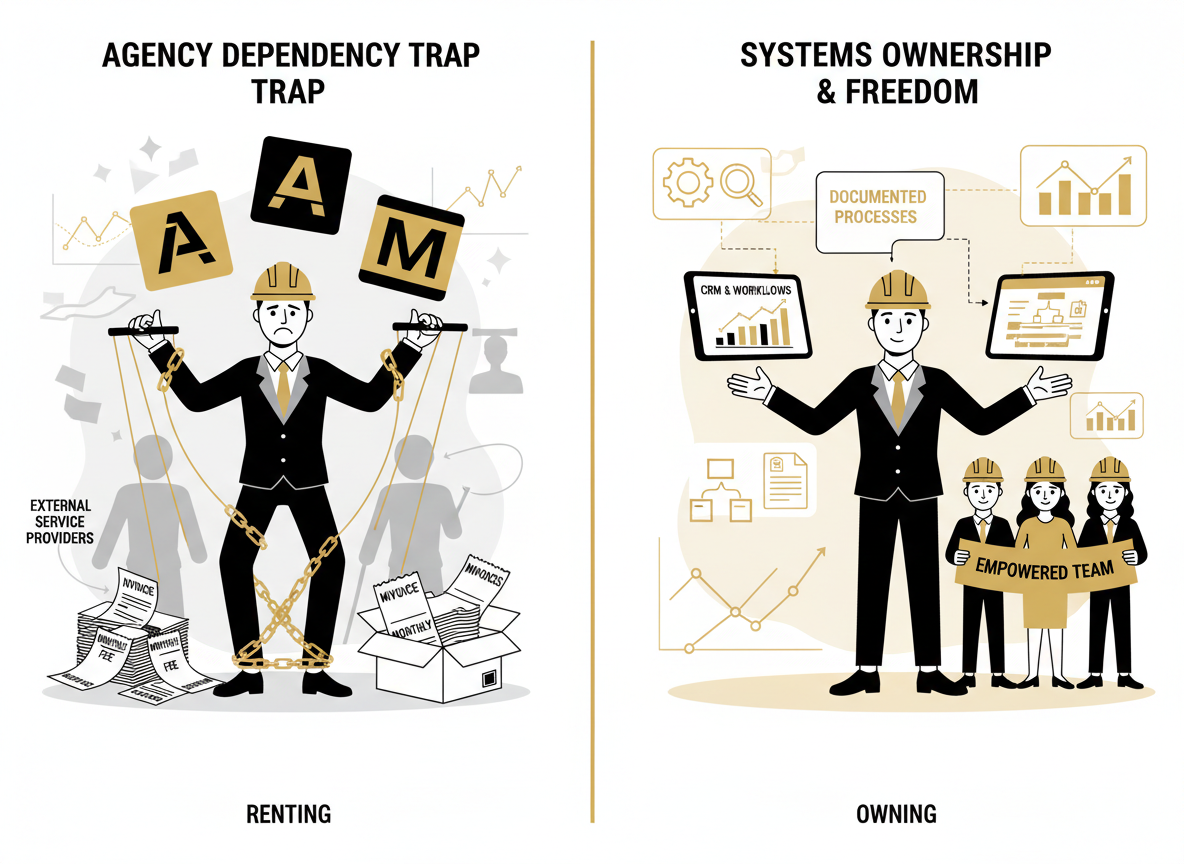
We're not building systems that only we can manage. We're building systems your team can own, maintain, and evolve. We train your people to run the systems. We document how everything works. We transfer capability, not create a new dependency.
The system becomes yours. You own it. You run it. That's the point.
The ConstructionKit™ Methodology: How Installation Works
At Gurler Mae, systems installation follows a proven methodology: ConstructionKit™.
ConstructionKit™ is the integrated system that installs SalesKit, OpsKit, and TeamKit into your construction business, creating predictable revenue, controlled delivery, and scalable teams.
Here's how each kit works:
SalesKit: Predictable Revenue
What it installs:
- CRM structure with clear pipeline stages and mandatory fields
- Lead qualification framework (scorecards, disqualification criteria, ideal client profile)
- Follow-up process (speed-to-lead standards, touchpoint sequences, escalation triggers)
- Pricing framework (margin bands, approval thresholds, quote templates)
- Activity standards (quotes per week, follow-ups completed, proposals issued)
- Pipeline forecasting dashboard (total value, weighted forecast, deal age, conversion rates)
What it delivers:
- 60–90 days of pipeline visibility
- £500K+ in approved work within 30–45 days
- 30–40% improvement in lead-to-quote conversion
- 50%+ reduction in time spent on unqualified leads
- Predictable revenue that allows confident planning
Timeline: 4–6 weeks from audit to fully operational system
OpsKit: Controlled Delivery
What it installs:
- Client handover process (sales-to-ops transition, kickoff checklist, expectation setting)
- Job tracking system (milestones, capacity planning, issue escalation, weekly status)
- SOPs for repeatable processes (site setup, subcontractor management, quality checks, closeout)
- Capacity management framework (project load, resource allocation, bottleneck identification)
- Weekly operations rhythm (standups, scorecards, issue resolution, leadership review)
What it delivers:
- Smooth handover from sales to delivery (no dropped details)
- Real-time visibility into job status and capacity
- Faster issue resolution (escalation paths, not firefighting)
- Consistent delivery quality (documented standards, not tribal knowledge)
- Reduced founder involvement in day-to-day operations
Timeline: 4–6 weeks from audit to fully operational system
TeamKit: Scalable Teams
What it installs:
- Role clarity and authority mapping (what each role owns, decision thresholds, escalation boundaries)
- Hiring scorecards (must-haves, red flags, interview questions, assessment criteria)
- Onboarding process (first 30/60/90 days, training checklist, success metrics)
- Performance standards (KPIs, weekly scorecards, accountability cadence)
- Communication rhythm (team meetings, one-on-ones, feedback loops)
What it delivers:
- Clear ownership (team knows what they're responsible for without asking)
- Better hiring decisions (structured criteria, not gut feel)
- Faster onboarding (new hires productive in weeks, not months)
- Self-managing teams (accountability without founder micromanagement)
- Reduced founder dependency (business runs without you in every decision)
Timeline: 4–6 weeks from audit to fully operational system
ConstructionKit™: The Integrated System
Most construction businesses don't need just one kit, they need all three, installed in sequence based on their biggest constraint:
- If revenue is unpredictable: Start with SalesKit
- If delivery is chaotic: Start with OpsKit
- If you're the bottleneck: Start with TeamKit
Each kit takes 4–6 weeks to install. Most clients complete all three within 12–16 weeks.
The result: A construction business with predictable revenue, controlled delivery, and scalable teams—systems that work together, not in silos.
What Systems Installation Looks Like in Practice
Let's walk through what actually happens during installation:
Phase 1: Systems Audit (Week 0)
What happens:
- 60–90 minute diagnostic session (15–20 min intake + 45–60 min live review)
- We map your current state: pipeline, sales process, CRM, operations, bottlenecks, team structure
- We identify 3–5 growth constraints
- We recommend which kit(s) to install first and in what sequence
- We clarify fit: Is your business ready for installation? Are you willing to enforce adoption?
What you get:
- Clear diagnosis of what's broken
- Specific recommendation on what to install
- Transparent view of timeline, investment, and expected outcomes
- Decision point: move forward with installation or not
No sales pitch. No pressure. Just clarity.
Phase 2: Installation (Weeks 1-4)
What happens:
- We build the systems directly in your business (CRM setup, process documentation, framework creation)
- We work with your tools (HighLevel, HubSpot, Airtable, Zoho—or migrate if necessary)
- We train your team in context (live walkthroughs, role-specific training, real scenarios)
- We set usage rules and enforcement standards from day one
- We hold weekly check-ins to track progress, address gaps, and adjust for compliance
What you get:
- Working systems installed in your CRM and workflows
- Team trained and using the systems with real data (not test cases)
- Clear standards for what "good" looks like
- Weekly accountability to ensure adoption
This isn't consulting. This is building the infrastructure your business needs to scale.
Phase 3: Enforcement & Optimization (Weeks 5-6)
What happens:
- We review usage data weekly (CRM activity, pipeline health, process compliance)
- We flag gaps and non-compliance immediately
- We work with leadership to enforce adoption (this is where most consulting fails—we don't)
- We optimize systems based on real-world friction (adjust for usability, not convenience)
- We confirm the system is embedded and self-sustaining
What you get:
- Systems that are actually being used (not sitting in a folder)
- Team accountability for following the process
- Leadership equipped to enforce standards without us
- Measurable results (pipeline visibility, conversion rates, time saved, bottlenecks removed)
If the system isn't being used, it's not installed. We don't leave until it's working.
Phase 4: Handover & Capability Transfer (Week 6+)
What happens:
- We document how everything works (system logic, maintenance, troubleshooting)
- We train your leadership to manage and evolve the systems
- We transfer full ownership (you run it, you own it, you control it)
- We offer optional ongoing advisory for clients who want continued support (monthly, limited capacity)
What you get:
- Full ownership of the systems
- Capability to maintain and improve them without us
- Option to continue working together if you want (but no dependency)
The goal is self-sufficiency. You should be able to run these systems without us. That's how you know installation worked.
| Consulting | Installation |
|---|---|
| Tells you what to do | Does it for you |
| Delivers recommendations | Delivers working systems |
| Hopes you implement | Builds and enforces adoption |
| Generic frameworks | Construction-specific systems |
| Paid for advice | Paid for results |
The ROI of Systems Installation
Let's talk numbers, because systems installation is an investment, and you need to know what return to expect.
Typical Investment Range
- Single Kit (SalesKit, OpsKit, or TeamKit): £8K–£15K depending on complexity
- ConstructionKit™ (all three kits, sequenced): £20K–£35K depending on business size and current state
- Timeline: 4–6 weeks per kit; 12–16 weeks for full ConstructionKit™
Expected Returns (First 60 Days)
SalesKit:
- £500K+ in approved work within 30–45 days
- 30–40% improvement in lead-to-quote conversion
- 60–90 days of pipeline visibility (vs. flying blind)
- 50%+ reduction in time spent chasing unqualified leads
- Predictable revenue forecasting (can plan hiring, investment, growth)
OpsKit:
- 20–30% reduction in project delivery time (fewer delays, better handover)
- 40%+ reduction in firefighting and reactive problem-solving
- Clear capacity visibility (know what you can take on without overloading)
- Improved client satisfaction (fewer miscommunications, clearer expectations)
- Founder time saved: 10–15 hours/week (removed from day-to-day operations)
TeamKit:
- 50%+ reduction in founder decision-making bottleneck
- Faster hiring decisions (structured scorecards vs. gut feel)
- 30–40% faster onboarding (new hires productive in weeks, not months)
- Team accountability without micromanagement (self-managing systems)
- Business can run 2+ weeks without founder involvement (holiday test passed)
Long-Term Compounding Returns (6–12 Months)
- Scalable growth: Revenue can increase without proportional founder time increase
- Business value: A systemized business is worth 3–5x more to a buyer than a founder-dependent one
- Team capability: Your team becomes more valuable (trained, accountable, self-managing)
- Competitive advantage: You can move faster, quote more accurately, deliver more consistently than competitors still running on chaos
- Founder leverage: Your time shifts from firefighting to strategy, growth, and high-value decisions
ROI Guarantee:
We guarantee measurable progress in the first 30–60 days:
- Pipeline visibility and qualified opportunities (SalesKit)
- Operational clarity and reduced firefighting (OpsKit)
- Reduced founder dependency and clear team ownership (TeamKit)
If you execute on the system and see no momentum in 60 days, we reassess or disengage.
We don't keep clients who aren't getting results.
Who Systems Installation Is For (And Who It's Not For)
Systems installation isn't for everyone. Here's who it works for—and who should look elsewhere:
✅ Installation Is For You If:
- You're a construction/property business doing £1M–£10M revenue (or on a clear path there)
- You have proven demand but lack the systems to scale predictably
- You're tired of consultants who deliver decks but don't build anything
- You're willing to enforce system adoption with your team (we support, but you lead)
- You want ownership of the systems (not dependency on an agency or consultant)
- You're ready to invest in infrastructure, not just tactics
- You understand that systems take 4–6 weeks to install and require discipline to embed
❌ Installation Is NOT For You If:
- You're looking for quick fixes or magic bullets (systems take time to build and embed)
- You want advice but aren't ready to implement (hire a consultant instead)
- You're not willing to enforce CRM usage, process compliance, or accountability standards
- You're in cash-flow desperation mode (fix cash flow first, then install systems)
- You want to stay in the middle of every decision (systems remove you from the bottleneck, that's the point)
- You're resistant to data, reporting, or visibility (systems require measurement)
- You're not the decision-maker or don't have authority to enforce change
Systems installation requires leadership buy-in. If the founder won't enforce adoption, the system won't stick,
regardless of how well it's built.
We pre-qualify for this in the Systems Audit. If you're not ready, we'll tell you. No point wasting your time or ours.
Common Objections to Systems Installation (And the Truth)
Objection 1: "We've tried systems before and they didn't stick."
The truth: You tried consulting, not installation. You got recommendations, not working systems. You were expected to implement while running the business. Installation is different, we build it, enforce it, and don't leave until it's embedded.
Objection 2: "Our business is different. Generic systems won't work for us."
The truth: We don't install generic systems. Every installation is customized to your business, your clients, your projects, your team, your constraints. We work with construction businesses exclusively, so we understand the unique challenges: long sales cycles, project-based delivery, thin margins, people-heavy operations.
Objection 3: "We don't have time to implement systems right now."
The truth: That's exactly why you need installation, not consulting. We don't add to your workload, we remove you from the bottleneck. Installation happens for you, not by you. And the longer you wait, the more revenue you leave on the table.
Objection 4: "My team will resist new systems."
The truth: Resistance is normal. That's why enforcement is built into installation. We set usage rules from day one. We train in context. We review compliance weekly. We work with you to hold the team accountable. If your team won't follow the system, we address it immediately, not six months later when it's too late.
Objection 5: "This sounds expensive."
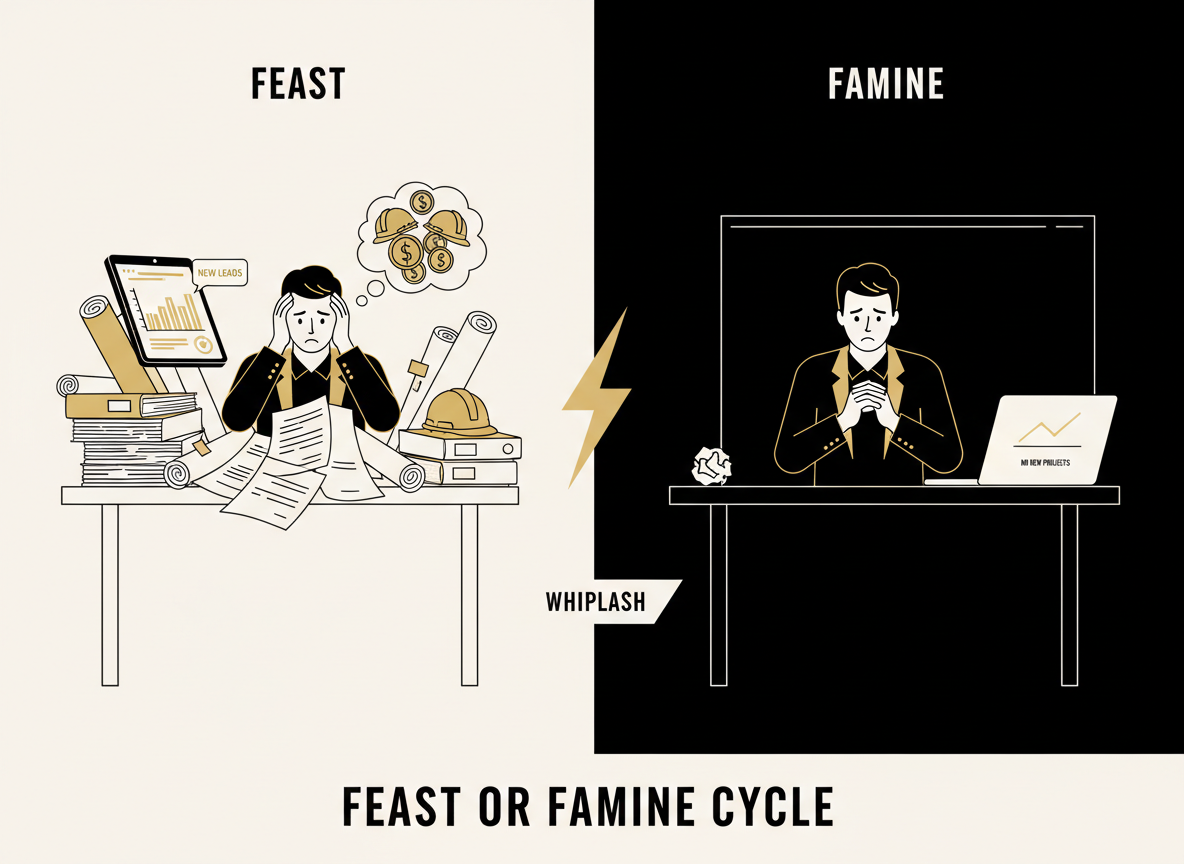
The truth: Compared to what? Staying stuck in feast-or-famine? Losing £500K+ in pipeline because you can't see or manage it?
Burning out because you're the bottleneck in every decision? Hiring consultants who deliver decks that sit unused?
Systems installation is an investment in infrastructure. The ROI is measurable, guaranteed, and compounds over time. The real cost is not installing systems and staying stuck.
Objection 6: "Can't we just use software to solve this?"
The truth: Software is a tool, not a system. Buying a CRM doesn't create pipeline visibility, it just gives you an empty database. Installation means setting up the CRM correctly, training your team to use it, enforcing adoption, and integrating it into your workflows. The software is 20% of the solution. The other 80% is structure, process, and enforcement.
How to Get Started with Systems Installation
If you're ready to move from chaos to systems, here's the path:
Step 1: Book a Systems Audit
The Systems Audit is a free, 60–90 minute diagnostic session where we:
- Map your current state (pipeline, sales, operations, team, bottlenecks)
- Identify 3–5 growth constraints
- Recommend which kit(s) to install first and in what sequence
- Clarify timeline, investment, and expected outcomes
- Assess fit (are you ready? Are we the right partner?)
No sales pitch. No pressure. Just clarity on what's broken and what needs to be installed.
Book your Systems Audit here →
Step 2: Decide to Install (or Not)
After the audit, you'll have complete clarity on:
- What systems you need
- What the installation process looks like
- What it will cost and how long it will take
- What results to expect in 30–60 days
You decide whether to move forward. If you're not ready, we'll tell you what to fix first. If you're ready, we start installation immediately.
Step 3: Installation Begins (4–6 Weeks Per Kit)
We build the systems directly in your business:
- Week 1-2: Build (CRM setup, process documentation, framework creation)
- Week 3-4: Train (team onboarding, live walkthroughs, real-world usage)
- Week 5-6: Enforce (usage review, compliance tracking, optimisation, handover)
You get working systems, embedded in your workflows, used by your team, delivering measurable results.
Step 4: Own and Scale
Once installation is complete, the systems are yours. You own them. You run them. You control them.
We offer optional ongoing advisory (monthly, limited capacity) for clients who want continued support, but there's no dependency.
The goal is self-sufficiency.
That's the difference between installation and consulting. We build it, you own it, it works.
Why Gurler Mae Does Installation Differently
There are plenty of consultants in the construction space. There are CRM providers, process improvement firms, business coaches.
But there's no one else doing true systems installation for construction businesses.
Here's why Gurler Mae is different:
1. Construction-Specific Expertise
We only work with construction and property businesses. We understand the unique constraints: long sales cycles, project-based delivery, thin margins, cash flow tied to milestones, people-heavy operations, founder-led decision-making at scale points.
We're not bringing generic frameworks from other industries. We're building systems designed for construction reality.
2. Installation, Not Consulting
We don't deliver recommendations and leave. We build the systems, install them in your business, train your team, enforce adoption, and don't leave until they're embedded and working.
You don't get a deck. You get working systems.
3. Founder-Led, Systems-Driven
Emre and Leyli (co-founders) have built, scaled, and systemized businesses. They've lived the founder bottleneck, the feast-or-famine cycle, the chaos of growth without structure.
Gurler Mae uses the same systems we install for clients, just with stricter enforcement. We practice what we preach.
4. Limited Capacity, High Standards
We only onboard three businesses per month. This isn't a volume play. We're not trying to scale a consulting firm. We're focused on depth, customisation, and results.
If you're not ready, we'll tell you. If you won't enforce adoption, we won't work with you.
We're selective because installation only works when both sides are committed.
5. ROI Guaranteed
We guarantee measurable progress in 30–60 days. If you execute on the system and see no momentum, we reassess or disengage.
We don't keep clients who aren't getting results. Success is the only metric that matters.
The Bottom Line: Consulting vs. Installation
If you've been burned by consultants before, here's why:
Consultants sell advice. Installation delivers systems.
Consultants tell you what to do. Installation does it for you.
Consultants leave after recommendations. Installation stays until it's embedded.
Consultants hope you implement. Installation enforces adoption.
Consultants create more work for founders. Installation removes founders from the bottleneck.
In construction businesses—where founders are already stretched thin, teams resist change, and "we'll get to it later" means never, installation is the only approach that actually works.
If you're tired of advice that doesn't stick, frameworks that don't get implemented, and consultants who deliver decks but don't build anything, it's time to try installation.
Book your Systems Audit here → and let's install the systems your construction business actually needs to scale.